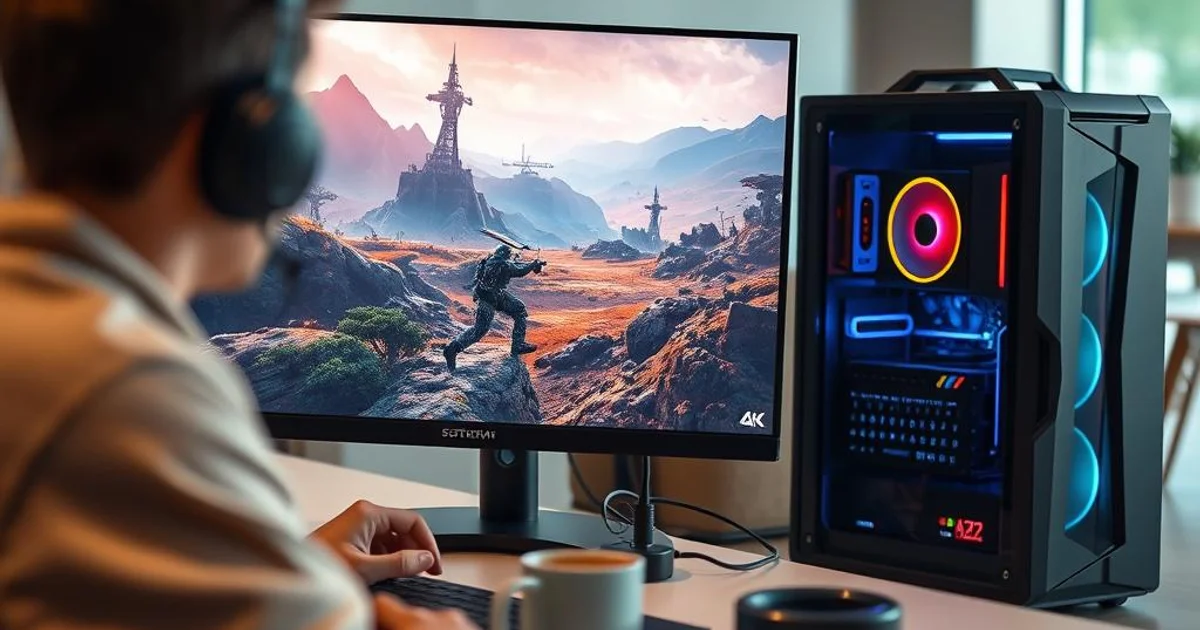
4k gaming stopped feeling like a luxury once i ditched my 1440p monitor
At a glance:
- 4K gaming is now practical for most enthusiasts thanks to modern GPUs and upscaling tech
- A 32‑inch 4K 240 Hz MSI monitor offers 138 PPI, a 27% increase over a comparable 1440p panel
- AMD Radeon RX 9070 XT and Nvidia’s DLSS make 4K performance smooth even on mid‑range rigs
Why 4k is becoming mainstream
The last few years have seen a rapid shift in the performance‑to‑price ratio of high‑end graphics cards. Where a 2022 Radeon RX 7900 XTX struggled to sustain playable frame rates at native 4K, the 2025 Radeon RX 9070 XT delivers a comfortable experience with the help of AMD’s FidelityFX Super Resolution (FSR) 3.0. Nvidia’s competing DLSS 3.5 also adds frame‑generation AI, allowing many titles to exceed 60 fps at 3840×2160 while preserving visual fidelity. This hardware‑software synergy means the “luxury” label that once stuck to 4K gaming is fading.
Another factor is the proliferation of high‑refresh‑rate 4K panels. Monitors that push 200 Hz and above are no longer niche; manufacturers such as MSI, Asus, and LG ship 4K models with 240 Hz refresh rates and sub‑10 ms response times. When paired with a GPU that can keep up, the combination delivers both crisp detail and buttery‑smooth motion, a sweet spot for competitive and immersive gaming alike.
Pixel count and ppi differences
Resolution alone tells only part of the story. A 1440p display packs 3,676,400 pixels, while a true 4K screen holds 8,294,400 – more than double the pixel count of 1080p and nearly a full 2× increase over 1440p. The jump from 1920×1080 to 2560×1440 feels sizable, but moving to 3840×2160 quadruples the pixel density, which translates into noticeably sharper edges and finer textures.
Pixel‑per‑inch (PPI) further clarifies why size matters. The author’s 32‑inch MSI 4K monitor registers 138 PPI, compared with 92 PPI on a same‑size 1440p panel and 109 PPI on a 27‑inch 1440p screen. That 27 % boost in PPI is why 4K looks dramatically sharper, especially when the GPU can sustain high frame rates. Larger screens that stay at lower resolutions suffer from visible pixelation, so the industry trend is toward pairing bigger panels with higher native resolutions.
Impact of upscaling tech like dlss and fsr
Machine‑learning upscalers have been the true game‑changers for 4K adoption. Nvidia’s DLSS uses a dedicated Tensor core to reconstruct a higher‑resolution image from a lower‑resolution render, adding frame‑generation to push performance even further. AMD’s FSR, now in its third iteration, operates on a broader range of hardware and has closed the visual gap with DLSS in many titles.
Both solutions allow gamers to run titles at 1440p or even 1080p internally while outputting a 4K‑scaled image that looks close to native. The result is a smoother experience without the steep performance penalty traditionally associated with 4K. As drivers mature, these upscalers become more consistent, making the “4K‑only” mindset obsolete for most mainstream gamers.
Personal hardware journey and monitor specs
The author’s transition illustrates the broader market shift. After years on 1440p, a 2022 purchase of a 49‑inch 5120×1440 super‑ultrawide provided immersive real estate but fell short of true 4K sharpness. The breakthrough came with an AMD Radeon RX 7900 XTX, which still felt limited, prompting a return to 1440p.
A year later, the Radeon RX 9070 XT paired with the MSI MPG 321URXW delivered a compelling 4K experience. The monitor’s key specifications are:
- Resolution: 3840 × 2160
- Refresh rate: 240 Hz
- Screen size: 32‑inch
- Aspect ratio: 16:9
- Response time: 0.03 ms
With these specs, the author reports “epic gaming experiences” where frame rates no longer dominate the conversation. The combination of high PPI, ultra‑fast refresh, and AI‑driven upscaling demonstrates that 4K gaming has moved from a niche hobby to a viable mainstream choice.
What this means for the future of PC gaming
Looking ahead, the trend suggests that 4K will become the default baseline for new monitor purchases, especially as GPU prices stabilize and next‑gen consoles continue to push 4K performance. Manufacturers are already experimenting with 5K and 8K panels, but the current sweet spot remains 4K at 144‑240 Hz, balanced by AI upscalers.
For builders, the takeaway is clear: invest in a GPU that supports the latest DLSS or FSR version, and pair it with a high‑PPI 4K panel. Doing so future‑proofs a rig for upcoming titles that will increasingly rely on machine‑learning rendering techniques. As the ecosystem matures, the line between “high‑end” and “mainstream” will continue to blur, making ultra‑sharp, fluid gaming accessible to a wider audience.
FAQ
What resolution and refresh rate does the MSI MPG 321URXW monitor support?
Which graphics cards does the author mention as pivotal for the 4K transition?
How does pixel‑per‑inch (PPI) affect image quality on different sized monitors?
More in the feed
Prepared by the editorial stack from public data and external sources.
Original article