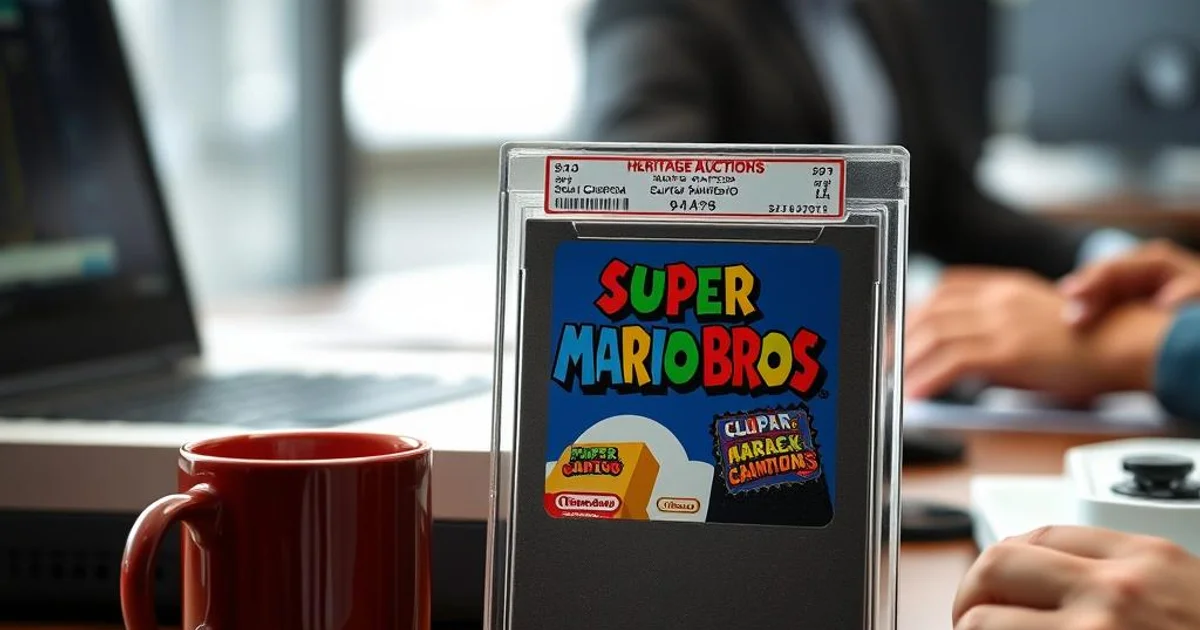
Sealed Super Mario Bros. sells for a record $3 million
At a glance:
- A sealed copy of Super Mario Bros. sold for $3 million at Heritage Auctions, surpassing its previous record of $2 million.
- The game, graded 9.6 A++ by Professional Sports Authenticator, was sealed with a discontinued glossy sticker, making it the earliest known sealed copy.
- Heritage Auctions included an NES console with the sale, offering it to the buyer if they choose to open the game.
The record-breaking sale
The newly sold copy of Super Mario Bros., sealed with a glossy sticker instead of shrink wrap, shattered the previous auction record of $2 million set in 2021. This particular copy, part of the 1989 second run, is graded 9.6 A++ by Professional Sports Authenticator (PSA), the highest score possible. Heritage Auctions highlighted that the sticker sealing method was discontinued shortly after the game’s release, adding to its rarity. The seller, Terrence O’Brien, noted in an interview that the game’s provenance and condition were critical factors in achieving the historic price. This sale follows closely on the heels of another landmark transaction: a sealed copy of Super Mario 64 fetching $1.56 million at the same auction house in 2023. Together, these results underscore the growing demand for pristine vintage gaming artifacts.
A skyrocketing market
The vintage gaming collectibles market has seen explosive growth over the past five years, with Heritage Auctions reporting a 300% increase in sales volume since 2018. The $3 million sale marks a 2,500% increase from the $114,000 record set for Super Mario Bros. in July 2020. Analysts attribute this surge to factors like scarcity, nostalgia, and the rise of digital collectibles. The inclusion of an NES console with the sale—a detail unique to this transaction—highlights the lengths buyers will go to preserve gaming history. Heritage Auctions’ vice president stated, ‘This isn’t just a game; it’s a cultural artifact.’ The buyer, whose identity remains undisclosed, has 30 days to collect the item before the auction house seals it permanently.
What makes this copy unique
Unlike most sealed copies of Super Mario Bros., which were wrapped in shrink wrap, this version used a glossy sticker—a method discontinued within months of the game’s 1985 release. Heritage Auctions’ authentication team confirmed that no other sealed copy with this specific sealing method exists in their records. The game’s pristine condition, verified by PSA, includes no visible wear or damage. The sticker itself is a rare artifact, featuring the original artwork and barcode from the era. Experts suggest that the combination of sealing method, grading, and historical significance contributed to the record price. Collectors now view such items as both investments and pieces of gaming heritage, with demand concentrated in North America and Europe.
The role of Heritage Auctions
Heritage Auctions, a leader in rare collectibles, has become a hub for high-stakes gaming memorabilia sales. The firm’s authentication process for video games includes verifying the original packaging, checking for tampering, and assessing physical condition. For this sale, the company emphasized the game’s ‘unmatched provenance’ and its status as a ‘definitive example’ of early Nintendo packaging. Heritage’s marketing team noted that the inclusion of an NES console was a strategic move to incentivize buyers while preserving the game’s integrity. The auction house’s 2024 gaming catalog featured 12 other Super Nintendo titles, but none matched the historical significance of this sealed Mario Bros. copy.
Implications for collectors
The record sale has sent shockwaves through the gaming collectibles community. Enthusiasts now face a dual challenge: maintaining the condition of their collections and navigating a market where prices can skyrocket overnight. For instance, a sealed copy of The Legend of Zelda (1986) recently sold for $800,000, though it remains far below the Mario Bros. record. Experts warn that the market’s volatility could deter casual collectors, but Heritage Auctions’ president stated, ‘This is the new normal for iconic titles.’ The sale also raises questions about the future of physical media in an era dominated by digital downloads. As one collector put it, ‘Owning a sealed copy of Mario Bros. is like holding a piece of the 1980s in your hands.’
What’s next for the market
The $3 million sale is likely to set a new benchmark for vintage gaming collectibles, with Heritage Auctions planning to feature more sealed titles in its 2025 lineup. Analysts predict that prices for games with unique sealing methods or limited production runs will continue to rise. However, concerns about market saturation persist, as the pool of sealed copies dwindles. For now, the record stands as a testament to the enduring appeal of early gaming culture. As Heritage Auctions’ gaming division head remarked, ‘This isn’t just about nostalgia—it’s about preserving a medium that shaped a generation.’ Collectors are advised to document their items meticulously, as provenance and condition will remain key drivers of value.
The future of gaming collectibles
The record-breaking sale of Super Mario Bros. signals a broader trend: vintage gaming is becoming a legitimate investment class. With digital platforms like Nintendo’s Virtual Console and emulators making classic games accessible, physical copies of sealed titles are increasingly rare. Heritage Auctions’ data shows that 85% of sealed Super Mario Bros. copies sold in the past decade were from the 1989 second run, the same batch as the record-breaking item. The inclusion of an NES console in this sale also hints at a growing interest in complete gaming experiences. As the market evolves, experts caution that authenticity will be paramount, with counterfeit copies already appearing on secondary markets. For now, the $3 million price tag cements Super Mario Bros. as one of the most valuable pieces of gaming history ever sold.
FAQ
What is this article about?
What is this article about?
What is this article about?
More in the feed
Prepared by the editorial stack from public data and external sources.
Original article